The scorecard is a stopwatch
It is worth being unsentimental about this. Contact within a window, on site within a window, estimate uploaded within a window, documents complete, file closed. Quality of work rarely enters the score directly — it enters indirectly, through complaints and re-inspections, and those are handled as exceptions rather than as the main metric.
Accepting that changes what you invest in. Most shops that feel they are being scored unfairly are doing excellent work and losing points on administrative clocks nobody owns. The good news is that clocks are the most fixable category of problem in an operation.
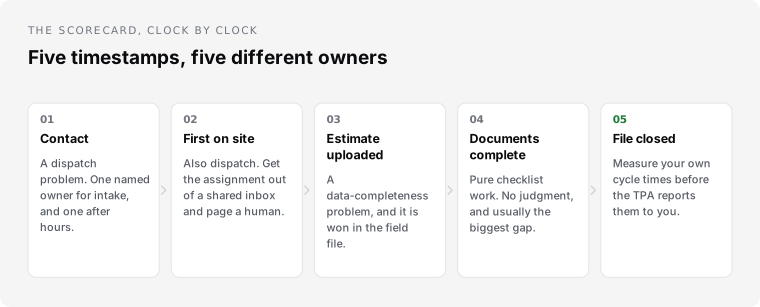
Contact and first on site are dispatch problems
When contact time is bad, the delay is almost never the technician. It is the assignment sitting in a portal, or an email in a shared inbox that four people can see and nobody owns. The fix is boring and it works: one named person owns intake during business hours and one named person owns it after, with a documented handoff between them.
After that, get the alert out of the inbox. The XactAnalysis API is open and you can automate against it rather than waiting for somebody to refresh a browser tab. A new assignment should page a human, not sit politely in a queue.
Estimate turnaround is a data-completeness problem
Estimates are almost never late because the estimator is slow. They are late because the field file is incomplete and the estimator has to call the technician, who is on another job, and that exchange costs a day. Missing dimensions, missing source photos, missing moisture readings, unclear on what came out.
So the intervention lands in the field, not in the estimating seat. Define what a complete file is, make it a checklist the tech closes out against before leaving, and audit it weekly. Estimate turnaround is the TPA metric that actually controls your job volume, and it is won or lost in the field file before the estimate is ever opened.
The estimate is late because the field file was incomplete, not because the estimator was slow.
Closing the file is the cheapest points on the board
Certificate of satisfaction, final photos, invoice, every document uploaded to the right place. This is pure checklist work, it requires no judgment, it is the least interesting thing in the company, and it is usually the biggest gap on the scorecard. It is also the easiest to systematize because nothing about it is a decision.
Last point, and it is the one that separates shops that improve from shops that complain: measure your own numbers before the TPA reports them to you. Export the job data, compute your own cycle times, and look at the distribution rather than the average — one file sitting open for ninety days will hide behind a fine-looking mean. The export is right there and the analysis is a spreadsheet, not a project.