What the sensors are genuinely good at
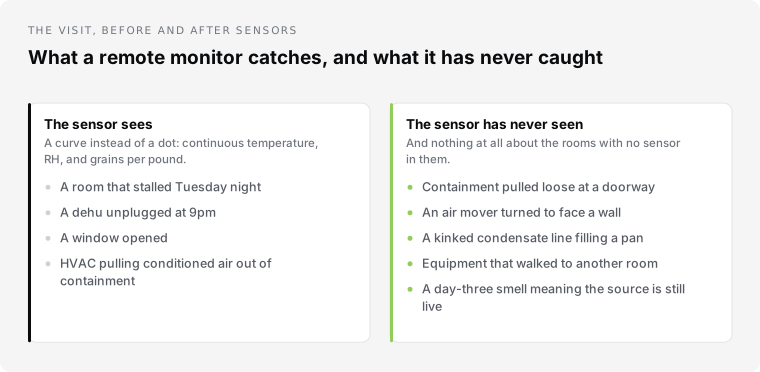
Continuous temperature, relative humidity, and grains per pound beats one reading a day by a wide margin, because you get a curve instead of a dot. A curve tells you the room stalled Tuesday night. A dot tells you Wednesday afternoon that the numbers are the same as yesterday, and by then you have burned a day.
They also catch things people do. Dehu unplugged at 9pm because it was loud. A window opened. HVAC cycling and pulling your conditioned air out of the containment. Those show up as a shape on the graph, and you would otherwise be guessing at them from a homeowner's account of their own week.
What a sensor has never caught for me
Containment pulled loose at the top of a doorway. An air mover that got turned to face a wall so somebody could get past it. A kinked condensate line quietly filling a pan. A hose someone stepped on. Equipment that walked to another room. A smell on day three that means the source is still live behind something you did not open.
And nothing at all about the rooms you did not put a sensor in. That sounds obvious right up until the job where the second floor was fine on Monday and you did not find out otherwise until Thursday.
A curve tells you the room stalled Tuesday night. Eyes tell you why.
The log is a legal document, not a dashboard
When somebody asks why you ran nine air movers and two dehus for six days, the answer is the daily log, and the log has to show a reading, a condition, and a decision. Automated readings fill in the first part beautifully and do nothing for the other two. "Room 3 GPP flat since day 2, added LGR, removed one AM from hallway" is a sentence a sensor will never write for you.
Undocumented equipment days are the first thing cut, and arguing them after the fact is a losing position. Answer the revision with documentation, which means it has to already exist. Write the note on the job, not from memory on Friday.
Use the data to change the visit, not skip it
The right way to use this stuff is to stop taking aimless trips and start taking purposeful ones. If the curve is dropping the way it should on four rooms and flat on one, you already know what today's visit is about before you get in the truck, and you bring the right piece of equipment with you instead of scheduling a second trip for it.
That is a real efficiency gain and it is not the one that gets sold. The pitch is usually fewer visits. The actual value is better visits, and a file that shows you were paying attention the whole time.