The revision email is a time tax
Every restorer knows the email. An adjuster comes back with a list of revisions meant to knock money off your invoice or estimate. In the example walked through in the video, a Mercury adjuster tries to remove $10,000 from a mitigation estimate. You did the work. Now you are expected to spend your afternoon justifying it.
The video's position is blunt: restoration work should not be dictated by someone who does not do restoration work. But if you are going to respond to revisions anyway, respond effectively. That means answering every objection with the industry-standard justification for the work, in writing, without burning your day on it.
Restoration work should not be dictated by someone who does not do restoration work.
Let a model draft the rebuttal
The first tool shown, called Refute, is a language model built to answer adjuster revisions. Paste in the full list of objections and it returns the reasons the work was performed and why it is justified per industry standards. Instead of composing a defense from scratch for each line, you review the draft, correct anything that does not match the job, and send it.
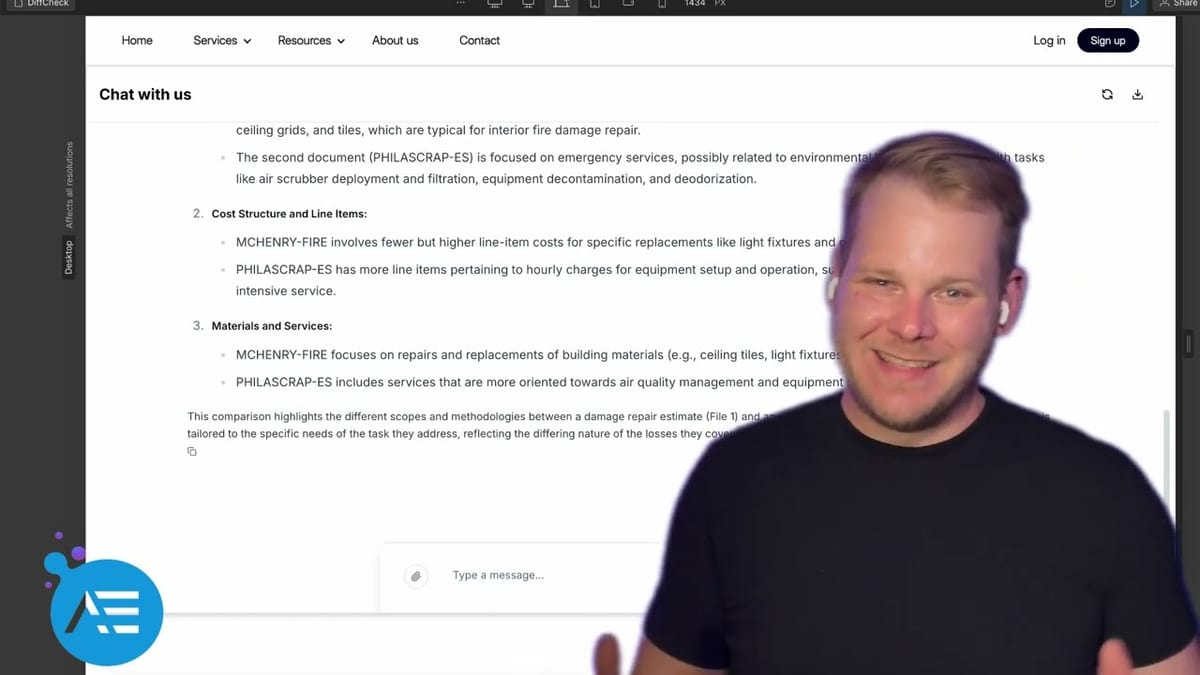
The second tool, Diff Check, takes the estimate the insurance company gives you and your own estimate and returns every difference between them — the same job a compare tool you can build yourself does on demand. A comparison only has something to say if your own scope exists first — a faithful copy of the carrier's estimate is still the carrier's estimate, and the items nobody wrote down are not in the file to argue about. From there you can ask follow-up questions: which big-ticket items are we apart on, why are my items justified, and what closes the gap between where the file sits now and approval, so you can start the work.
The stronger position is the lane argument
The video's larger point is not about tools. It is that adjusters are experts in policy, not in water damage or construction. When an adjuster says four days of drying will not be paid, that is not a contractual position. No policy excludes four days of drying. Force the conversation back to the contracts that actually govern the claim: you tell the client what the policy covers, the contractor tells the client what the property needs.
Held to that standard, most revision lists shrink fast, because the objections were never grounded in policy language to begin with. The tools exist to make the paperwork side of that fight cheap enough that you never concede scope just to save time.