Start with what comes back
A lot of software companies say they can write your Xactimate estimate with AI. That sentence can describe very different products. A proposed scope, a list of line items, a priced estimate and an editable file inside Xactimate are different deliverables. Before you compare speed, find out which one the clock is measuring.
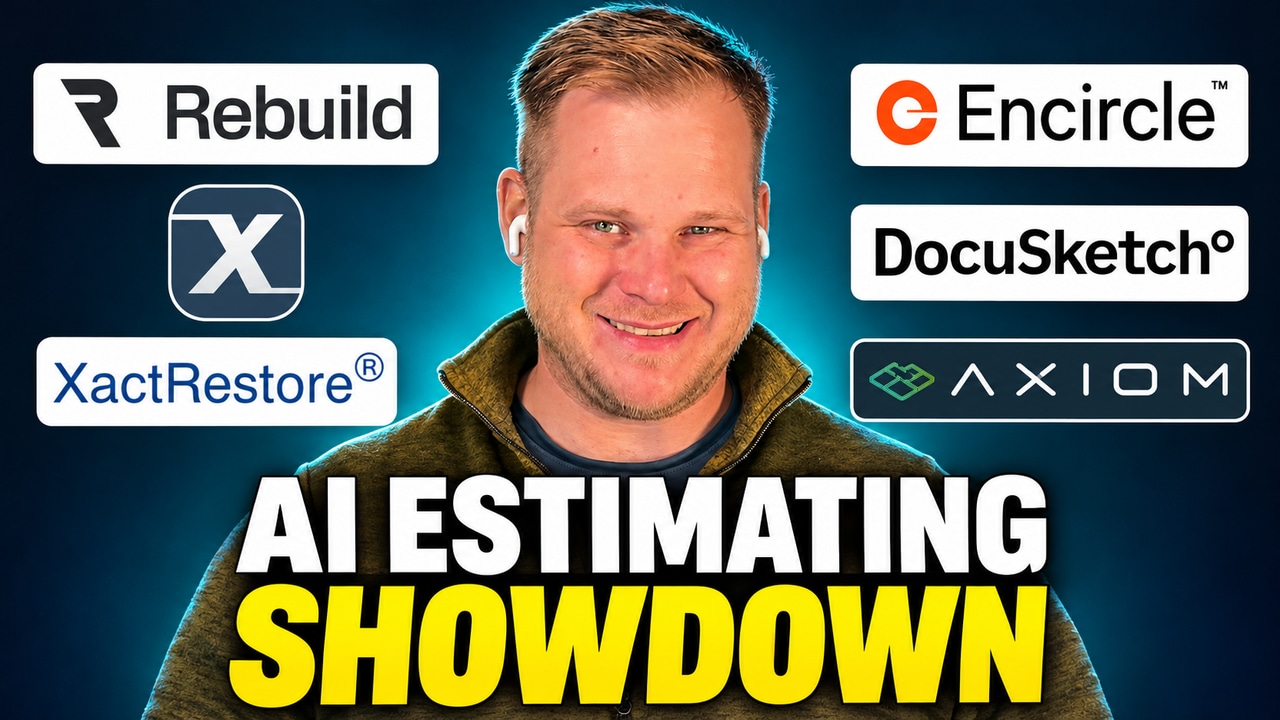
That is the question behind my video review of XactRestore, Rebuild, DocuSketch, Encircle and Axiom. I founded Axiom, so this is my perspective as a builder and restoration operator, not an independent benchmark. The standard I care about is practical: can your team use the documentation it already has, get a useful draft, and finish an estimate it can defend?
XactRestore: useful AI, with a workflow distinction
I gave the XactRestore experience a B-minus in the video, and I meant the positive part of that. The interface is clean. The conversational estimating tools are useful. A reconstruction contractor who has not spent years learning estimate writing can get into the workflow without facing the same learning curve as a veteran Xactimate user.
The distinction is where that particular experience lives. Verisk documents its AI Estimator within XactRestore and XactRemodel. That should not be confused with having the identical conversational workflow inside Xactimate. It also does not mean Xactimate has no AI: Verisk lists AI line-item recommendations and photo labeling there.
For a shop already operating in Xactimate, the useful demo is the entire handoff. Show the job being scoped, show the estimate being edited, and show how the result reaches the estimator's existing workspace. A clean interface helps. So does avoiding another place where someone has to rebuild the same job.
Rebuild: time the finished deliverable
My biggest objection to Rebuild in the video was the gap between a speed claim and the point when an estimator can use the result. Rebuild's estimating page advertises generation in 90 seconds or less and an export into Xactimate. Those are vendor claims. The test is to submit a real job and stay with it until the file is usable.
In the video, I describe accounts from people I know who reported waiting several hours for the ESX after receiving an initial scope. Those accounts are not a controlled timing study, and they do not establish what every Rebuild customer will experience. They do explain why I want vendors to separate time to first draft from time to finished delivery.
Rebuild's website also identifies the company as a Verisk ecosystem partner and displays an Xactimate integration badge. I challenged that claim in the video. A missing result in a public directory is not enough to prove a partnership does not exist. Ask for confirmation of the specific relationship and a demonstration of the actual integration. Similarly, an export delay alone does not establish who wrote the estimate or where the work happened.
My buying question remains the same: what happens after I click submit? Ask which steps are automated, whether a person reviews or writes the file, when you receive the priced estimate, and whether delivery interrupts your team's Xactimate session. Get those answers before committing your production workflow.
DocuSketch and Encircle: better inputs matter
I grouped DocuSketch and Encircle together in the review because the mitigation workflows I discussed address a problem every estimator recognizes: incomplete field documentation. I gave them a B-plus together. That was my assessment of those workflows, not a score from a common test set or a claim that their products are identical.
DocuSketch's strength starts with the room. A 360-degree capture gives the estimator context that scattered close-ups and missing notes often cannot. Its current product site distinguishes documentation, sketches and estimating services, including estimates delivered by certified estimators. Be specific about which service you are comparing; a camera workflow, an AI scope and a human estimating service are not interchangeable.
Encircle approaches the input problem through field documentation. Its Scope to Estimate workflow describes using photos, readings, notes and a floor plan to produce a mitigation scope, then send sketches and line items into Xactimate for review. Encircle says its Field Documentation product is required. That is a meaningful fit question if your crews already document jobs somewhere else.
The mitigation focus in my video should not be read as a blanket statement about everything either company offers. Evaluate the specific product for the job you need done. My positive view comes from the estimating outputs I have seen and the way both approaches improve the information reaching the office.
Where Axiom fits, and what I would test
We are building Axiom to work with the job documentation your team already collects. The aim is not to make you replace your CRM or field service system. The Axiom workflow brings photos, notes and measurements into a room-organized draft, lets your estimator review and refine it, and exports a native ESX for Xactimate. The supported connection or upload path matters, so check your field tools rather than assuming every platform has the same integration. Your team still owns the final scope.
Run the same representative job through each product you are considering. Include the photos, measurements, drying information and notes your crew would normally provide. Record when the first result arrives, then keep the clock running until the estimator can open and work with the deliverable. Count the corrections and the manual handoffs, not just the line items.
An estimate can arrive quickly and still take an hour to fix. It can include a long list of plausible items and still miss the work that matters. A useful review checks what was omitted, what was added without support, and whether quantities and work activities follow the actual loss. Our own claims deserve that scrutiny too.
- Deliverable: distinguish a scope, a priced estimate and an editable Xactimate file.
- Turnaround: measure the first draft and usable delivery separately.
- Labor: count vendor review, your estimator's corrections and any re-entry.
- Evidence: trace the proposed work and quantities back to the job documentation.
- Workflow: test the tools your crews use and the job types your shop actually handles.
Understanding AI is not enough. You have to understand what makes an estimate defensible.