Two products that stop at different files
Wave and Axiom are both trying to end the same problem: one experienced estimator is the whole department, and every job waits on that person. They take opposite routes to it. Wave replaces the estimating software. Axiom feeds it.
That is not a slogan, it is the product. Wave's own comparison pages say so plainly, and this piece quotes them rather than characterizing them. Every Wave claim here comes from buildwithwave.com as of August 22, 2026.
Read the output row first. Most of the decision is in it.
| Axiom | Wave | |
|---|---|---|
| Field input | Photos, measurements, notes, floor plans, roof reports, share links | Voice or text: you type or speak what you see on site |
| What builds the scope | Documentation the crew already collected | A conversation, with follow-up questions |
| Output file | Native ESX | |
| Opens in Xactimate | Yes, and reprices on import | No, ESX export is on Wave's roadmap |
| Where prices come from | Xactimate's price list for the job's own area code | A proprietary database Wave maintains |
| Catalog | Bound to the full Xactimate catalog | A tight restoration-focused line-item set, by design |
| Estimator review | Room by room, before anything is exported | Scroll the finished estimate, edit descriptions, quantities, prices |
| Pricing model | Monthly plan, unlimited users, an allowance per workflow | Monthly subscription with an included estimate count |
| List price | $899/mo for 15 estimates, $2,500/mo for 50 | $199/mo for 10, $299/mo for 20, $499/mo for high volume |
What Wave markets
Wave leads with 'The number. Day one.' The pitch is that a tech walks out of the loss with a complete, insurance-grade estimate already written. You talk or type the scope on site, Wave asks smart follow-ups, and it builds the estimate in real time. Then you review it, adjust anything, and export a clean PDF to share with the adjuster.
The published numbers are 90 percent day-one accuracy against a stated industry baseline of 80 to 85 percent, a 75 percent reduction in cycle time, and about 15 minutes from chat start to PDF export. The accuracy figure is attributed to internal review, which the site says openly.
The company is Claims AI, Inc., in Jersey City. Albert Aguilera is co-founder and president, a restoration operator and licensed general contractor with catastrophe deployments behind him. Michael Otis is CEO, a four-time founder out of Stord and Rubicon. Justin Trugman is CTO, formerly VP of software development at Caregility. Backed by BetterFutureLabs. There is real field experience in that founding team, and the writing on their blog shows it.
The one row that decides most of this
Ask Wave directly whether it exports an ESX and the answer on their own comparison page is: 'Not yet. Wave exports professional PDFs that adjusters accept and process. ESX export is on the roadmap.'
Their argument for why that is fine is a fair one, and worth repeating in full: 'Adjusters are used to receiving PDF estimates from many sources and evaluate them on scope and documentation quality, not the software that produced them.' For a homeowner-pay job, a cash claim, or a small carrier that just wants a number, that is true.
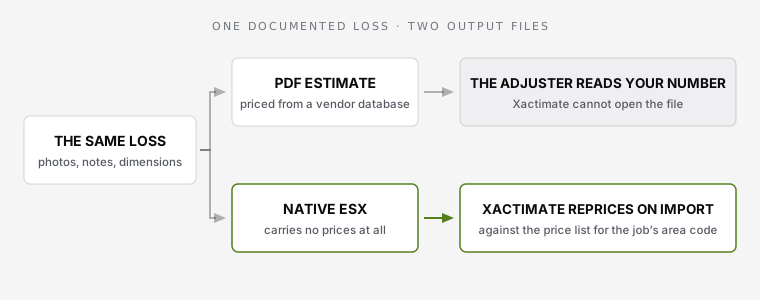
It stops being true the moment the file has to move as data. A carrier or TPA assignment that expects a Xactimate file wants an ESX. An adjuster who wants to reconcile your scope against theirs line by line wants an ESX. A supplement that has to attach to the original estimate wants an ESX. A PDF is a picture of an estimate. Somebody has to retype it before anyone can work in it, which is a whole product category on its own, and one Axiom already covers.
A PDF is a picture of an estimate. An ESX is the estimate.
Whose price list is the number on
This is the part that gets least attention and matters most on a disputed claim. Wave states it clearly: 'Wave uses a proprietary, curated price database maintained by our team with regional adjustments.' Their reasoning is that building their own 'lets us keep the line-item set tight and focused on restoration, without the bloat of 15,000 codes most of which you never use.'
Axiom does the opposite, and deliberately. An Axiom ESX carries no prices at all. Xactimate reprices every line on import against the price list for the job's own area code, on the date you import it. That is not a limitation we work around, it is the point. The estimate you send is priced by the same book the adjuster is holding.
The difference shows up in an argument. When your number comes from a vendor's own database, a disagreement over cost is no longer about scope, it is about whose price list is right, and yours is one nobody else in the claim uses. When the number comes from Xactimate's regional list, there is nothing to argue about except whether the line item belongs there. That is the argument you want to be having.
Those 15,000 codes are where the supplement lives
Wave is right that most losses use a few hundred line items. Anyone who has written mitigation scopes for a year knows the common water, fire, and mold jobs land on a small, repeating set. If you only ever wrote the obvious lines, a tight catalog would cost you nothing.
But the obvious lines are not where a shop makes or loses money. The tail is. The odd substrate, the specific detach and reset, the containment configuration a particular carrier will only pay for when it is written their way, the item an adjuster left off because it is rare. Axiom binds to the full Xactimate catalog, all 15,334 items, which is exactly the set the adjuster's software can see. If a code exists in Xactimate, it can appear in your estimate and it will price on import.
A curated database is a real design choice with a real trade-off, not a mistake. It makes the common job faster and the unusual job harder. Which one hurts more depends on the losses your shop actually runs.
Describing the room versus documenting it
The inputs differ as much as the outputs. Wave works from what the person on site says: 'You type or speak what you see on site.' Its accuracy therefore rides on how well that person narrates the loss, in the moment, out loud.
Axiom works from the record instead. Your crew is already taking photos, and how the room is photographed decides the ceiling on accuracy more than anything else in the pipeline. The documentation Axiom takes:
- Jobsite photos, plus the wide and boundary shots that decide accuracy
- Room measurements, and floor plans as ESX, PDF, or a photographed sketch
- EagleView and HOVER roof reports
- Technician notes and loss details
- CompanyCam, Encircle, and DocuSketch share links
- Projects captured in the Axiom field app
Both put a human in front of the file
On this the two products agree, and it is worth saying so. Wave has you scroll the finished estimate and fine-tune anything, editing descriptions, quantities, prices, and adding or removing line items. Axiom builds a first draft organized by room and the estimator inspects all of it: rooms, dimensions, affected areas, Xactimate codes, line items, editable quantities.
Where the documentation cannot settle a condition, Axiom asks a room-specific question rather than quietly adding a line item. Neither company is selling an estimate nobody reads, and neither should be. AI should give an estimator a head start, not take them out of the decision.
Wave is cheaper per estimate. Read what you get for it.
At list price this is not close, and pretending otherwise would be dishonest. Wave's Basic plan is $299 a month for 20 estimates, which is about $15 each. Starter is $199 for 10, about $20 each. Axiom's Starter plan is $899 a month for 15 estimates, about $60 each, and Pro is $2,500 for 50, exactly $50. Line up any pair of tiers and Wave is two and a half to four times cheaper per file, and that is before a slow month, in which Axiom's larger monthly figure is still billed in full.
So the question is not which number is smaller, it is what the extra buys. It buys a file Xactimate opens, priced by the same book the adjuster uses, drawn from the catalog the adjuster can see. If your claims settle on a PDF, that premium is money you do not need to spend, and you should not spend it.
One structural point that used to favor Axiom no longer does, and it is worth saying so plainly: both products are monthly plans with an included count now, so on either one a slow month is still billed and a busy month runs past the allotment. What is left of the difference is what the money covers. Users are unlimited on every Axiom plan, and on Pro the PDF-to-Xactimate and Compare workflows stop counting at all — two jobs Wave does not do. The plan price is the whole price: no seats, no hardware, no annual contract.
Where Wave is the better fit
There is a real shop this is right for. If your work is mostly residential water, fire, and mold, if your adjusters take a PDF without complaint, if your techs are comfortable narrating a loss out loud, and if nobody in the building wants to open Xactimate again, Wave is a clean answer at a genuinely low price. Their content on drying science and line-item practice is written by somebody who has done the work, and that shows up in the product.
The case gets harder as the loss gets bigger and more contested. Reconstruction, commercial, program work, anything where a carrier assignment expects a Xactimate file, anything that will end in a supplement fight. Those are the jobs where the file format stops being a formality.
If you are already on Wave
You do not have to pick a side to solve the ESX problem. PDF to Xactimate is one of Axiom's three workflows: it takes a finished estimate PDF and converts it into an importable ESX, which is exactly the gap Wave names on its own roadmap. It has its own monthly allowance — 15 conversions on Starter, uncapped on Pro — so converting a file does not spend an estimate. A shop can run Wave for speed on site and convert only the files that have to move as data.
That is a smaller purchase than switching, and it is a reasonable place to start if the PDF is the only thing standing between you and the claim.
The verdict
Wave is a fast, cheap, well-built way to leave the job site with a number, and its founders have clearly written estimates for a living. If the PDF is the deliverable, it is a strong buy.
Axiom is for the shop whose estimate has to survive contact with Xactimate: a native ESX, no prices carried in, repriced against the job's own area code, drawn from the full catalog, reviewed room by room by the estimator whose name is on it. Wave asks the industry to leave Xactimate. Axiom assumes you are not going to.
You do not have to take either pitch on faith. Book a demo and bring a job your team already wrote by hand. Run the original documentation through, then open the file next to the estimate you know is right. Do not judge AI estimating by the promise. Judge it by the file.
Common questions
- Does Wave export Xactimate ESX files?
- Not currently. Wave's own comparison page says: 'Not yet. Wave exports professional PDFs that adjusters accept and process. ESX export is on the roadmap.' Axiom exports a native ESX that opens directly in Xactimate.
- Is Axiom an alternative to Wave?
- Yes, though they solve the problem from opposite directions. Wave replaces the estimating software: you narrate the scope on site and it produces a PDF priced from its own database. Axiom feeds the estimating software: it reads the documentation your crew already collected and returns a native ESX that Xactimate reprices on import.
- Why does Axiom not carry prices in the file?
- Because Xactimate reprices every line on import against the price list for the job's own area code. An estimate that arrives with a vendor's prices baked in is priced by a book nobody else in the claim uses. Leaving prices out means the only thing left to discuss is whether the line item belongs there.
- Which one is cheaper?
- Wave, at list price. Wave's Basic plan is $299 a month for 20 estimates, about $15 each; Starter is $199 for 10. Axiom's Starter plan is $899 a month for 15 estimates, about $60 each, and Pro is $2,500 for 50, exactly $50 each — with unlimited users, and with PDF-to-Xactimate conversions and comparative estimates uncapped on Pro.
- Can I use Axiom to convert a Wave PDF into a Xactimate file?
- Yes. PDF to Xactimate is one of Axiom's three workflows, and it carries its own monthly allowance rather than spending an estimate: 15 conversions a month on Starter, uncapped on Pro.