The incumbent, and the thing it never automated
DocuSketch is the incumbent documentation platform in restoration, and it earned that position: 360 degree capture, immersive tours, precise sketches, and estimates delivered as ESX or FML. The company says it powers more than 50,000 claims a month, and that it is used by eight of the ten largest restoration franchise networks. Nothing in this comparison disputes any of that.
The part worth examining is narrower. DocuSketch's estimating product is not software you run. It is a service staffed by people. Their estimating page says it in one line: 'DocuSketch's certified, human estimators do the estimating for you.' That is a different purchase from the camera, on a different clock, at a price that scales with the size of your loss.
Every DocuSketch claim quoted here comes from docusketch.com as of August 22, 2026.
| Axiom | DocuSketch | |
|---|---|---|
| What it is | Estimating software your team runs | Documentation platform plus estimating as a service |
| Who writes the estimate | The software drafts it, your estimator approves it | Certified human estimators employed by DocuSketch |
| Turnaround | A draft comes back for estimator review | A claim-ready estimate within two business days |
| Capture | Photos, notes, and measurements your crew already collects | 360 degree tours from the DS1 camera |
| Hardware | None, a phone is enough | DS1 Field Camera Kit, about $795 one time |
| Sketch | Reads floor plans as ESX, PDF, or a photographed sketch | Digital floor plans in ESX or FML, reviewed by trained professionals |
| Estimate output | Native ESX you download | ESX for Xactimate or FML for Cotality |
| Pricing model | Flat monthly plan, unlimited users, no hardware | Percentage of line-item value, monthly minimum, usually an annual contract |
| What one estimate costs | $899 or $2,500 a month flat, whatever the loss | 0.8 to 1.0 percent of the estimate's line-item value |
| AI estimating | The whole product, mitigation and reconstruction | 360AI, preliminary mitigation only, Xactimate integration in progress |
What DocuSketch actually sells
There are three purchases inside DocuSketch and they are easy to blur together. The hardware, a DS1 Field Camera Kit at roughly $795 one time. The documentation and sketch subscription, from $379 a month for five tours and five sketches up to $1,095 a month for twenty, plus $129 per additional office location. And the estimating service, priced separately as a percentage of the estimates it writes.
The first two are the reason DocuSketch is in most trucks, and they are good. An immersive 360 tour is a genuinely better record of a loss than a camera roll, it settles arguments months later, and having the sketch come back as a real ESX or FML removes a job nobody enjoys. That is a strong product with a clear price.
The third is the one to look at closely, because it is not software and it is not priced like software.
Twenty-four hours on one page, two business days on another
The DocuSketch homepage says you 'Receive your completed estimate in as little as 24 hours.' The estimating page says 'Get a claim-ready estimate within two business days.' Both are their words, on their own site, on the same day.
Neither is a contradiction, exactly. 'As little as 24 hours' is a best case and 'within two business days' is the commitment. But the gap tells you what kind of system is behind it. Software does not have a best case measured in days. A queue of human estimators does.
That is the structural limit on the whole service, and no amount of demand changes it. When a storm lands and every shop in the region submits at once, a team of certified estimators is exactly as fast as a team of certified estimators. Two business days is not a bad number for hand-written work. It is just not a number that gets better.
Software does not have a best case measured in days. A queue of people does.
A percentage of your own estimate
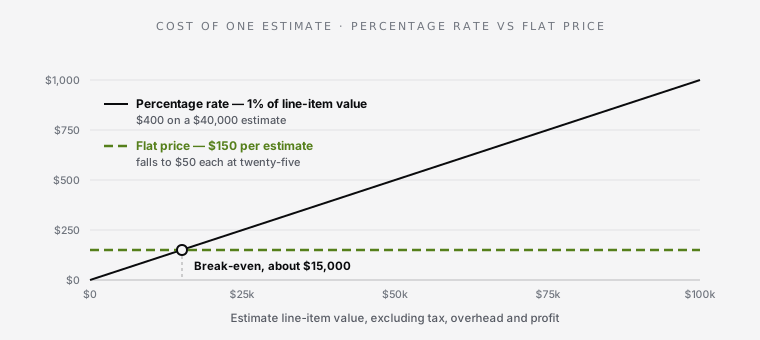
DocuSketch prices estimating like a broker, not like a tool: 'Pricing is based on a percentage of the total estimate line item value, excluding taxes, overhead, and profit, with monthly minimums based on your chosen package.' The published ladder runs from $500 a month and 1.0 percent at $50,000 of monthly estimate value, to $1,950 a month and 0.8 percent above $300,000. Most estimating packages include an annual contract.
Work through what that means for one file. A $40,000 reconstruction estimate costs $320 to $400 to have written. A $100,000 commercial file costs $800 to $1,000. The same scope, the same hours of work by the same estimator, priced differently because the loss was bigger. Your cost tracks the claim, not the effort.
Axiom is flat, and it is flat in the dimension that matters here: the bill does not move when the loss does. A $40,000 reconstruction file and a $4,000 water loss cost the same to write. Put the two on the same footing and the comparison depends on how full your month is. Starter is $899 for 15 estimates, so a shop that uses the whole allowance is at about $60 a file and a shop that writes five is at $180. Pro is $2,500 for 50, or exactly $50 at a full month. Against a 1.0 percent rate, a full Starter month crosses DocuSketch at about $6,000 of line-item value and a full Pro month at $5,000; write only a third of your allowance and the crossover moves out past $18,000. Below the crossover the percentage is cheaper, and on small mitigation files at low volume it genuinely is. Above it, every additional dollar of loss is free on Axiom and billable on DocuSketch.
The monthly minimum is the part that bites
The percentage is only half the pricing. The other half is that each tier carries a minimum you pay whether you use it or not, on what is usually an annual contract. At the entry tier that is $500 a month, which is exactly 1.0 percent of the $50,000 of estimate value the tier is sized for. The minimums are calibrated so the rate is a floor, not an average.
That is a fine deal for a shop with steady volume that always fills the tier. It is an expensive one for a seasonal business, or for the months between storms, or for a shop whose volume moves around. A slow quarter on an annual contract is paid in full. Axiom is a monthly commitment too and a slow month is still billed, and its floor is higher: $899 against DocuSketch's $500 entry minimum. The differences that are left are that Axiom is month to month rather than a year, that the $899 covers writing the estimates rather than only the right to be billed a percentage on top, and that the number does not move when the loss does.
Add the documentation subscription and the real operating number climbs, and you can do this arithmetic straight off their own pricing page. A shop on the ten-pack Standard documentation plan at $575 a month, plus the entry estimating minimum at $500, is at $1,075 a month before a single estimate is written, plus $129 for a second office and the camera kit up front.
360AI is real, and it is mitigation only
DocuSketch is not standing still. 360AI was announced in March 2026 with instant floor plans from 360 imagery, speech to scope with bilingual field notes, on-site estimates with confidence indicators, and a multi-year agreement with Verisk.
Their own product updates are more careful than the announcement, and to the company's credit they say so directly: 'Right now, 360 AI is focused on preliminary mitigation estimating, and we want to be clear about that.' On the Xactimate side: 'The Xactimate integration is in progress. We're building output to align with carrier requirements and estimating platforms.' Instant Sketch, Initial Estimate, 360AI Scoping, water mitigation and contents are all still summer-dated roadmap items.
So as of today the AI covers preliminary mitigation, the Xactimate output is in progress, and reconstruction still routes to the human estimating team. Reconstruction is the larger, higher-value, more disputed half of restoration. That is not a knock on their engineering, it is a statement about what you can buy this month.
Keep the camera. Axiom reads its output.
This is the part most comparisons get wrong by framing it as a switch. It is not. DocuSketch's capture layer and Axiom's estimating layer are not the same purchase and they compose cleanly.
Axiom already takes DocuSketch share links as input, alongside CompanyCam and Encircle, and it reads floor plans as ESX, PDF, or a photographed sketch. If your crews are trained on the DS1 and your sketches come back clean, that is a documentation process worth keeping. Nothing about running Axiom asks you to put the camera down.
What it does let you question is the estimating retainer sitting on top of it: the percentage, the minimum, the annual term, and the two business days. Those are separable from the capture you actually value.
What Axiom does with the same job
Axiom starts from documentation the crew already produces, and returns a draft organized by room. The estimator inspects all of it: rooms, dimensions, affected areas, Xactimate codes, line items, editable quantities. Where the documentation cannot settle a condition, the software asks a room-specific question instead of quietly adding a line item. Nothing is final until the estimator says so.
The file that comes out is a native ESX carrying no prices. Xactimate reprices every line on import against the price list for the job's own area code, so the estimate is never tied to anyone else's pricing. You download it, store it with the claim, and import it when it suits you.
And photos to a draft is one of three workflows, all included in the one plan. PDF to Xactimate converts a finished estimate PDF back into an importable ESX. Compare puts the carrier's estimate next to yours, shows what was left out, and returns a reconciled file with justification notes.
Where DocuSketch is genuinely better
Three things, and they are not small. The 360 tour is a better record of a loss than photos are, full stop, and it keeps paying off every time somebody asks months later what a room looked like on day one. Axiom does not sell a camera and does not produce a tour.
Second, DocuSketch sells to carriers and independent adjusters, not only contractors, and publishes hard outcomes on that side: cycle times cut by days, desk-adjusting limits raised, one top-ten carrier reporting more than $35 million saved. If your program work runs through carriers already standardized on DocuSketch, that alignment has real operational value.
Third, a human estimator is a human estimator. On an unusual commercial loss with contradictory documentation, a certified writer with forty years in the trade will make judgment calls no software makes today. The trade is that you wait two days for it and pay a percentage of the result.
The verdict
DocuSketch is the safe, complete, expensive answer, and for a franchise network standardized on it there is little reason to move the capture layer. The estimating service is the piece worth pricing honestly against what it replaces: a percentage of your own line-item value, a monthly minimum on an annual term, and a two-business-day clock that does not compress under volume.
Axiom is the other half of that trade. A flat price that stops rising when the loss gets bigger, a draft back in minutes rather than days, reconstruction included today rather than roadmapped, and a native ESX you hold. Keep the camera if it works. Run the estimating math again.
You do not have to take either pitch on faith. Book a demo and bring a job your team already wrote by hand, with the DocuSketch sketch attached. Run the original documentation through, then open the file next to the estimate you know is right. Do not judge AI estimating by the promise. Judge it by the file.
Common questions
- Is Axiom an alternative to DocuSketch?
- For estimating, yes. For 360 degree capture, no. DocuSketch sells a camera, immersive tours, sketches, and estimates written by its own certified human estimators. Axiom is software your team runs that drafts the estimate from documentation you already collect and returns a native ESX. Axiom accepts DocuSketch share links and floor plans as input, so the two can run together.
- How much does DocuSketch estimating cost?
- It is priced as a percentage of the estimate's line-item value, excluding taxes, overhead, and profit, with monthly minimums: $500 a month and 1.0 percent at $50,000 of monthly estimate value, rising to $1,950 a month and 0.8 percent above $300,000. Most estimating packages include an annual contract. On a $40,000 reconstruction estimate that is roughly $320 to $400 for one file.
- How long does DocuSketch take to deliver an estimate?
- The DocuSketch homepage says 'in as little as 24 hours' and its estimating page says 'within two business days.' The estimates are written by certified human estimators, so the turnaround is bounded by staffing rather than by processing time.
- Does DocuSketch's AI write reconstruction estimates?
- Not yet. DocuSketch's own product updates say 360AI 'is focused on preliminary mitigation estimating' and that the Xactimate integration 'is in progress.' Reconstruction estimating still routes to their human estimating team. Axiom covers mitigation and reconstruction today.
- Do I need a 360 camera to use Axiom?
- No. Axiom works from jobsite photos, room measurements, technician notes, floor plans as ESX, PDF or a photographed sketch, EagleView and HOVER roof reports, and CompanyCam, Encircle or DocuSketch share links. There is no hardware to buy.