Same file format, opposite ends of the claim
CapOut and Axiom both hand you a Xactimate ESX, which is why they get compared. They are not competing for the same moment on the job. CapOut starts from a scope somebody else already wrote and reproduces it as data. Axiom starts from a loss nobody has scoped yet and produces the first one.
That distinction sounds academic until you price it. A shop that only converts the carrier's PDF has already accepted the carrier's scope as the starting point of the negotiation. A shop that writes its own scope first is negotiating from its own.
Every CapOut claim quoted here comes from capout.ai as of August 22, 2026.
| Axiom | CapOut | |
|---|---|---|
| Required input | Photos, measurements, notes, and job details | A carrier PDF that already exists |
| What it produces | A scope that did not exist before | A faithful ESX of a scope somebody else wrote |
| What the AI decides | Which line items the damage implies | Which line items are on the page |
| Benchmark | Line-item recall against estimates written by hand | 99.99 percent across 3,000-plus real scopes |
| Speed | A draft back for estimator review | About 90 seconds to 2 minutes, 5 to 6 on very large scopes |
| Coverage | Photos, PDF to Xactimate, Compare | PDF to ESX, plus material and labor orders and profit analysis |
| Pricing | $899/mo for 15 estimates and 15 conversions; $2,500/mo for 50 estimates and unlimited conversions | $35 per export, or $349/mo for 15 |
| Behind it | Restoration operators who wrote the estimates | XSQRD INC, the company behind SquareDash |
What CapOut does, and does well
CapOut's promise is 'Convert any PDF to ESX in seconds,' and by every public account it delivers on it. You upload a carrier PDF and get back a ready-to-work ESX with line items, pricing, folder structure, F9 notes, and paid-when-incurred items intact. A 167-page, 3,546-line-item scope processed end to end in two minutes thirty seconds.
In August 2026 they moved off routing files through the Xactimate API to a XactNet address and started generating the ESX directly, which in their words 'gives us full control over every line item, price, folder, and F9 note in your scope.' That is the right call and it is the same conclusion Axiom reached: if the file matters, write the file yourself.
The problem they picked is a good one. Re-keying an adjuster's scope by hand is hours of work that produces nothing new, and it is exactly the kind of task that should have died years ago.
Read the accuracy number correctly
CapOut reports 99.99 percent accuracy across an evaluation set of nearly 3,000 real insurance scopes, with every line item, quantity and value matched. There is no reason to doubt it, and publishing an eval number at all is more than most of this category does.
What matters is what the number measures. It is a transcription benchmark: given a document that already contains the answer, did the system reproduce it. That is a real engineering achievement and it is a well-posed problem, because there is exactly one correct output and it is printed on the page.
Scoping has no answer key on the page. Given photos of a wet room, deciding which line items the damage implies is a judgment, and two competent estimators will write it differently and both be defensible. Held to a transcription standard, no scoping system will ever score 99.99 percent, and any vendor claiming it is measuring something else. Contractors will hear '99.99 percent accurate ESX' and reasonably assume it covers both jobs. It does not, and CapOut has never said it does.
Transcription has one right answer printed on the page. Scoping does not.
Where each one sits on the claim
Lay the two against the sequence of an actual claim and the overlap resolves itself. Documenting the loss, originating the scope, converting the carrier's estimate, and reconciling the two are four different jobs, and a converter can only start at the third.
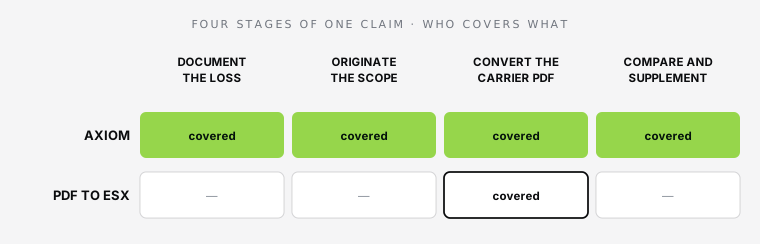
If you only transcribe, you have accepted their number
This is the operational point, and it has nothing to do with software quality. When the carrier's scope is the only scope, every conversation that follows is about their list. The items they left out are not in the file to argue over, because nobody wrote them down.
The money in restoration is in that gap. The containment they did not include, the detach and reset they skipped, the drying configuration priced for a smaller loss, the line items an adjuster comes back to strip out. A perfect transcription of an incomplete scope is an incomplete scope, rendered perfectly.
Axiom's Compare workflow exists for exactly this: put the carrier's estimate next to yours, show what was left out, and return a reconciled file with justification notes attached. That only works if you have your own scope to compare against, which means somebody had to originate one.
Axiom converts PDFs too, and it is one of three workflows
PDF to Xactimate is one of Axiom's three workflows, so the specific job CapOut does is covered. It is not the reason to buy Axiom, and for that job alone it is not cheaper. CapOut sells 15 exports for $349 a month, about $23 each; Axiom's Starter plan includes the same 15 conversions inside an $899 plan that is mostly buying you the estimating. Pro takes the cap off conversions entirely, but nobody pays $2,500 a month for unlimited transcription. If re-keying carrier scopes is the only problem in your shop, CapOut is the better buy and you should make it.
What the plan buys is three different document problems on the same claim, each with its own monthly allowance rather than one shared pot. Field data to a room-organized draft. A PDF back into an importable ESX. Compare for reconciliation. That is why Axiom behaves less like a converter and more like an estimating workspace.
Both companies agree on one thing worth noting. CapOut says it 'works alongside the estimating and workflow systems your team already uses' and does not replace them. Axiom takes the same position: Xactimate stays where it is, and the file arrives ready to open.
Who is behind CapOut
Worth knowing, because it explains the roadmap. CapOut is not an independent startup. The legal entity is XSQRD INC, which is SquareDash, the contractor payment-advance platform, with roughly $20 million in equity and a credit facility on top of it. Founder and CEO Matt Fruge has owned a Dallas-Fort Worth construction company since 2010 and founded SquareDash in 2022, so there is a real operator behind the product and the content voice reflects it.
That parentage matters in a specific way: SquareDash already holds a financial relationship with restoration contractors, advancing money against claims. CapOut deepens it, and the product line beyond conversion, profit breakdown by trade, material and labor orders, margin visibility, follows that logic. It is a production and cash-flow play built on top of scope data, not an estimating play.
Axiom started somewhere else. Jakeb Shelton spent ten years in restoration and exited a company he built, running crews and writing the Xactimate. Matthew Gregory built the estimating engine, trained on real restoration claims rather than a general vision model with a restoration label on it. The product reflects that too: it is built around the moment the estimate gets written.
Where CapOut is the better buy
If your shop's bottleneck is a stack of carrier PDFs waiting to be retyped, CapOut solves that faster and cheaper than anything else reviewed here, and the batch processing on their Pro plan is built for exactly that pile. Program contractors handling high volumes of carrier-originated scopes are the clearest case.
It is the wrong tool for a shop whose problem starts earlier. If nobody has written a scope yet, there is no PDF to convert, and no amount of transcription accuracy helps. Those are complementary problems, not competing ones, and a shop can honestly have both.
The verdict
CapOut is a well-built product with an honest benchmark, solving a real and specific problem: getting an existing scope out of a PDF and into Xactimate without retyping it. Judge it on that and it is very good.
Axiom is for the earlier decision. It writes the scope from the documentation your crew collected, shows the estimator every room, code, and quantity before anything is exported, and hands back a native ESX carrying no prices that Xactimate reprices against the job's own area code. The one number to keep straight is that 99.99 percent measures reproduction. Whether your scope is complete is a different question, and it is the expensive one.
You do not have to take either pitch on faith. Book a demo and bring a job your team already wrote by hand. Run the original documentation through, then open the file next to the estimate you know is right. Do not judge AI estimating by the promise. Judge it by the file.
Common questions
- Is Axiom an alternative to CapOut?
- They solve different problems on the same claim. CapOut converts an existing carrier PDF into a Xactimate ESX. Axiom originates the scope from photos, measurements and notes when no estimate exists yet. Axiom also includes PDF to Xactimate as one of its three workflows, so the conversion job is covered, but that is not the reason to buy it.
- What does CapOut's 99.99 percent accuracy actually measure?
- Transcription. CapOut reports 99.99 percent across an evaluation set of nearly 3,000 real insurance scopes, matching every line item, quantity and value against the source document. It measures how faithfully an existing scope is reproduced, not whether the right line items were chosen for a loss nobody has scoped yet.
- Which one is cheaper for converting a PDF?
- CapOut, for conversion on its own. It publishes $35 per export, or $349 a month for 15 exports, about $23 each. Axiom bundles 15 conversions into its $899 Starter plan alongside 15 estimates and 15 comparative estimates, and uncaps conversions entirely on the $2,500 Pro plan — so Axiom is cheaper only if you are buying the estimating as well.
- Who owns CapOut?
- The legal entity is XSQRD INC, the company behind SquareDash, a contractor payment-advance platform. Founder and CEO Matt Fruge has owned a Dallas-Fort Worth construction company since 2010 and founded SquareDash in 2022.
- Why does it matter whether the scope is originated or transcribed?
- Because a transcription of the carrier's scope makes the carrier's scope your starting point. Items they left out are not in the file to discuss. Writing your own scope first, then comparing it against theirs, is what surfaces the difference and gives a supplement something to stand on.